


North Cyprus Real Estate Market: Steady Growth on the Back of a Strong Economy. The basis of the economy is formed by private business, which ensures stable domestic demand and investment in construction, tourism and the rental housing sector for students and professionals. North Cyprus is small Economy, but with a fairly lively private sector. In 2023, the State Pension Fund received almost 2 billion liras in insurance premiums, and the lion’s share of this money came from private businesses. The public sector gave about 650 million, the private sector about 1.3 billion. This means that the main engine of the economy is not officials, but construction, trade, tourism, and service.
The number of officially insured employees is increasing:
In 2019, there were about 124 thousand of them, by 2023 there were already 140 thousand.
Yes, unemployment in 2023 rose to 7.3% against 6.1% a year earlier, but against the background of the region, this is still a moderate level.
Average salaries.
In the public sector about 28 thousand liras per month, in the private sector about 22 thousand. That is, domestic demand for rent and services, especially in large cities, is supported not only by tourists, but also by local residents and visiting specialists.
The population at the end of 2023 is about 420 thousand people.
At the same time, the young group of 20-34 years old dominates. This is important: the young population is students, employees of universities, services, IT, medicine. All of them either rent or buy housing.
Foreign trade.
Northern Cyprus is still strongly tied to Turkey both as a political partner and as an economic one. Almost $2 billion of imports come from Turkey. Other major partners are Germany, Italy, Great Britain, China, Poland.
Exports are primarily dairy products, textiles, fruits, olive oil, wine.
The main buyers are Turkey and the countries of the Middle East.
Construction and real estate.
In 2023, 433 new buildings were registered, of which 417 are private.
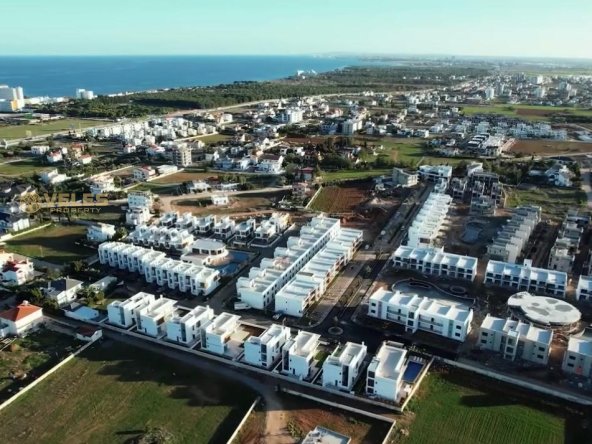
Most of the construction is in Lefkoşa, Famagusta, Girne, as well as in the coastal districts of Esentepe and Iskele. That is, exactly where there is an active development of tourism, apart-hotels, residential complexes by the sea.
It is important to understand that these are no longer selective projects of “one villa on a hill”. These are large-scale complexes with tens and hundreds of housing units, complete infrastructure and a focus on long-term rentals and buyers from abroad.
The next driver is education.
There are more than 20 universities in Northern Cyprus.
The total number of students in 2023 is about 108 thousand people.
Half of them are foreigners. The main countries are Turkey, Nigeria, Pakistan, Iran, Jordan, Egypt, Syria, Tajikistan, Azerbaijan.
In fact, students and related people (teachers, service staff, families) outnumber the population of some cities.
This means a constant demand for rentals not only in the center of Girne and Lefkoşa, but also in the areas around the university areas. For the investor, this is a separate, stable market segment.
Healthcare also does not stand still.
29 public and 18 private medical institutions, growing interest in medical tourism.
Most often, people come here from Turkey and the Middle East for operations, examinations, procedures.
This is another flow of people who need short-term and medium-term rental of apartments, apartments, hotels.
Agriculture remains the classic basis:
olives, citrus fruits, grapes, wheat, plus the production of dairy products over 20 thousand tons per year.
Some of these products are exported, some are used for domestic demand and the tourism sector: hotels, restaurants, cafes.
Now the most interesting thing for many is tourism.
Year 2023:
the total tourist flow through official points is about 2.36 million people, and in total, taking into account the crossing through southern Cyprus, almost 5.8 million.
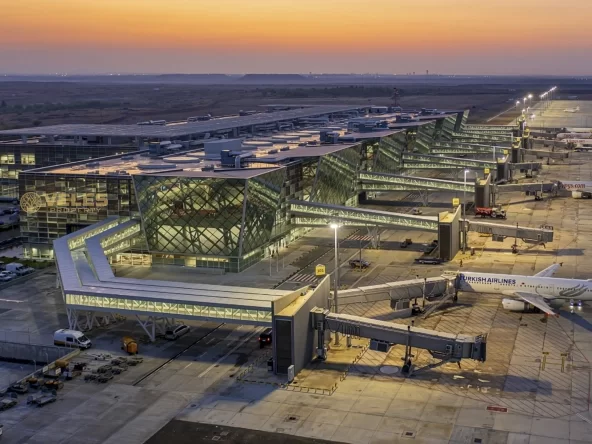
93–94% of all international guests arrive through Ercan Airport.
The leaders in the number of tourists are Turkey, Germany, Great Britain, Russia, Iran, Kazakhstan, Azerbaijan and a number of European countries.
There are almost 3.9 million overnight stays in hotels, the average occupancy is 44%.
At the same time, one detail: hotels with casinos are loaded by about 64-65%, without casinos about 40%. That is, the “casino + hotel” segment remains a powerful magnet.
2024 consolidates the trend:
Tourist traffic grows to 2.2 million people through official points, and almost 4.8 million additional people enter through the south.
Flows from Germany, Israel, Kazakhstan, France, and Central Asian countries have increased.
The total number of overnight stays is more than 4.28 million, the number of rooms is about 27.5 thousand beds.
63% of all beds are in five-star hotels.
That is, Northern Cyprus is gradually turning into a resort with an emphasis on high-level hotels and comprehensive service.
2025, January–September:
The tourist flow continues to grow.
About 1.88 million people came through the airport and ports, plus more than 3.3 million through the southern part of the island.
The average hotel occupancy for nine months is 44.7%, in summer it rises to 60-66%.
The leaders in terms of loading are Famagusta, Iskele and Girne.
As for the leading countries, the picture is as follows:
Turkey remains number one,
Germany and the United Kingdom show stable growth,
Israel – a record increase, more than doubled,
Poland, Kazakhstan, France, Azerbaijan, and the United States are adding.
In general, tourism has been growing for three years in a row. Yes, there are drawdowns within the year by month, but the trend is clear: there are more people, the geography is expanding, and the number of rooms and infrastructure continue to be built up.
What does all this mean for real estate?
First, the economy and the population.
A young demographic profile, growing employment and an influx of students are creating a steady demand for rental housing in both cities and coastal areas.
Secondly, construction.
The new offer is concentrated in the resort and seaside areas of Iskele, Long Beach, Esentepe, Karsiyaka, Tatlısu, areas around Girne and Famagusta.
Where tourism and infrastructure are growing, developers are also going there.
Thirdly, tourism, education and medicine together create a diverse demand:
short-term vacation rentals,
medium-term for students and families,
long-term for those who move and apply for a residence permit.
In terms of profitability, the rental market in popular locations gives up to 10-12% per annum in foreign currency with a competent selection of the object and professional management.
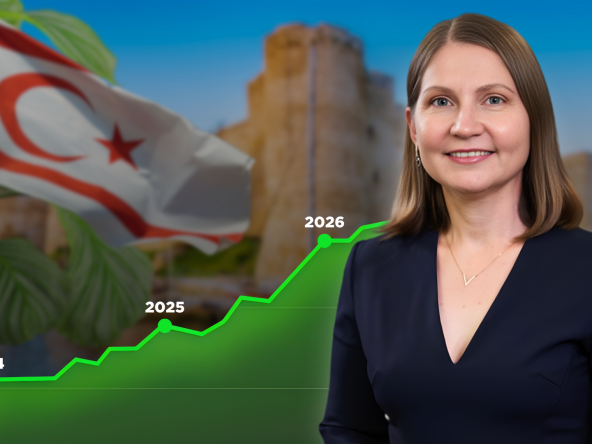
Now the main question is: what to expect next if we are on the threshold of 2026?
With a high degree of probability, we can expect:
- further growth of tourist traffic, especially from Turkey, the Middle East and some European countries;
- active development of the five-star segment and large resort complexes;
- Continued high rental demand in coastal areas and around university centres;
- continued construction in key regions near the sea with a gradual increase in prices for quality projects;
- strengthening the role of the private sector and service industries.
At the same time, it is important to understand that Northern Cyprus remains dependent on Turkey, and new regulations and changes in laws continue to be issued in the field of real estate, especially in terms of purchases by foreigners.
This means that the simple approach of “seeing a beautiful complex and buying” no longer works. An analytical, legally verified choice is needed.